
Four years ago, HR Manager Hanna Fjällström spent two days chasing addresses in a spreadsheet. Today, she runs HR for three countries part-time, and the latest pulse survey came in at nine out of ten.
Codemill gets more out of Hailey every year
Before Codemill started using Hailey in 2022, the company had no HR system at all. One of Hanna's first tasks was sending Easter eggs to every employee during the pandemic, but first she had to check that everyone's home address was correct. That took two days.
"Today, it feels completely absurd not to be able to simply pull up a list of basic employee data. It's often these small, simple things, like having everything in one place, that save a huge amount of time."
In the beginning, it was mainly about getting the master data into one place, which suited Codemill well since Hailey's functionality was fairly limited at the time. Since then, the platform has developed rapidly, and Codemill has kept pace. The HR system today means something entirely different to what it did four years ago.
"I'd say we use pretty much everything. Whenever something new is released, I read up on it and implement it straight away if it's relevant for Codemill. The only thing we don't use is time reporting, and there's a reason for that."
And even for time reporting, which they've kept running in a separate system, they've found a way to make use of Hailey: holiday and leave requests are submitted and approved there.
"In our time-tracking system, managers don't get a notification to approve leave, only the hours themselves. Hailey has closed that gap too, so managers now have much better visibility of employees' absences."
Stress-free salary reviews with custom workflows
What has really transformed Hanna's day-to-day work are the custom workflows, Hailey's feature for building your own, tailored processes. They run quietly in the background, and what once required a nudge from HR now happens on its own.
But not every workflow was built from scratch. The salary review, a dedicated workflow within Hailey, is the clearest example. It used to live in parallel spreadsheets that were copied back and forth.
"The pay review used to be a bit of a headache every time. Now Hailey guides you through the whole process, so you always know which stage you're at and what to do next. It's taken away so much of the worry."
Around the salary review, Hanna has built her own tailored workflows that remind and prepare everyone for what needs doing before and after, for example when managers need to book salary discussions or employees need to prepare for their own. Together, they add up to a seamless process from start to finish.
The same principle eventually solved the address hunt too: updates are now handled by a workflow that, with a single click, asks every employee to log in and fill in their own details.
The lesson that frees up HR: give managers ownership
When Hanna became HR Manager, she had one employee in her team. Today, she's the only person in HR and works on it only part-time, with her role having evolved into Head of Brand and People.
It sounds like an impossible equation: less time, more responsibility. But the logic holds up.
"I couldn't have managed the day-to-day without Hailey. There's no way I'd have been able to broaden my role like I have."
A large part of this efficiency comes from ownership shifting out to the managers, who receive automatic reminders and keep track of one-to-ones, follow-ups and probation periods themselves, without HR having to nudge every step along.
"As HR, there's a real difference between firefighting and being able to work proactively and strategically. Having so much handled automatically is what gives me the space to actually do that."
This has allowed Hanna to get closer to the business itself. As Head of Brand and People, she spends a large part of her time on marketing, right in the middle of the business and close to her colleagues in their day-to-day work. She doesn't just meet them for HR matters, she works alongside them, which makes her as much a colleague as an HR function.
"As an HR person, I want to work with people, rather than sitting and typing into a system. Now the day-to-day runs fairly automatically, but when someone really needs help, I can make the time for it."
Three countries, one community
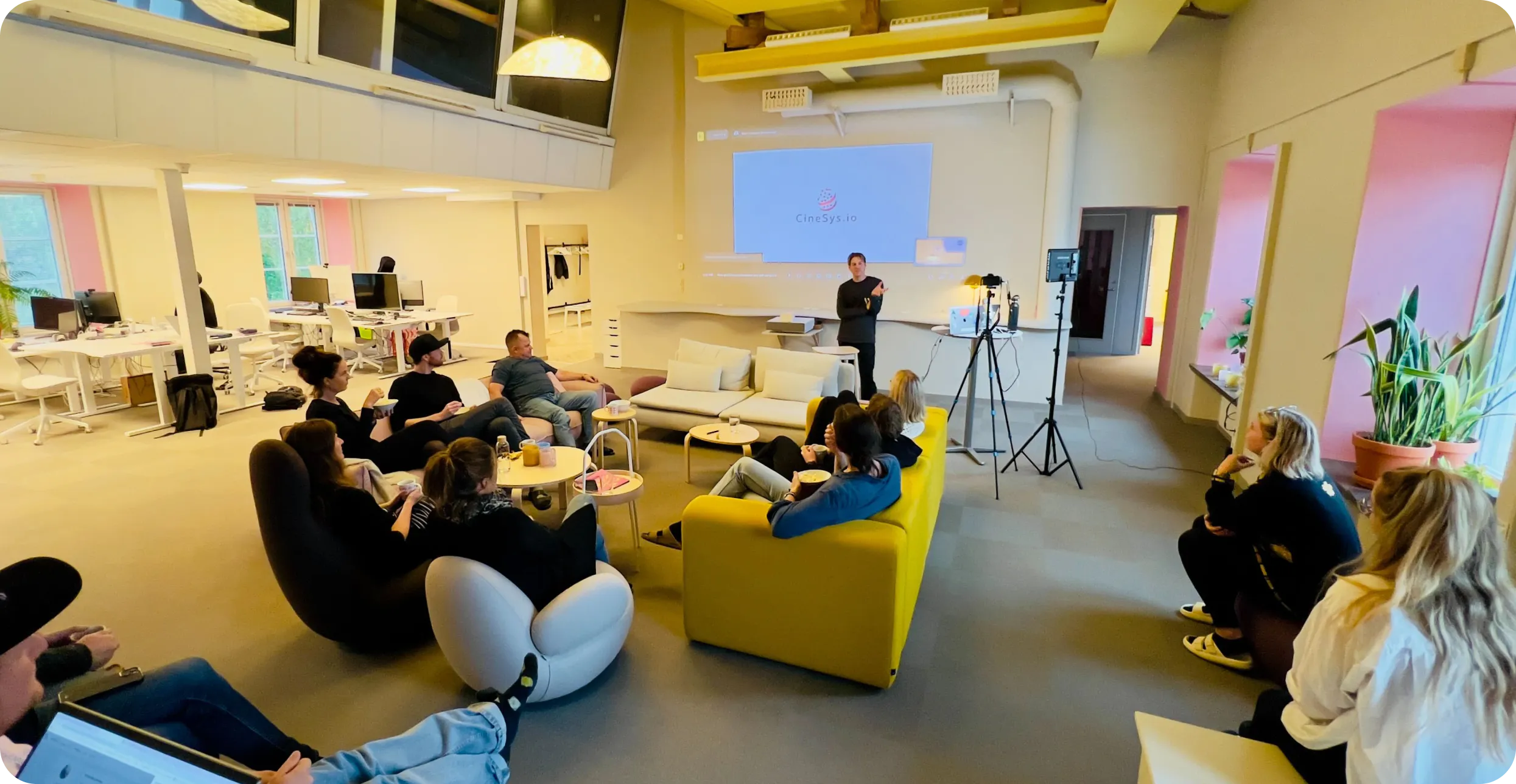
Codemill is a small company, but it operates across three countries. Alongside the Swedish operation, there's a US and a UK entity, with employees based close to customers in the US and the UK. The real challenge isn't administering three countries, it's making everyone feel like they work in the same place.
"Working with us should feel exactly the same whether you're in Sweden, the UK or the US. Everyone experiencing the same processes in Hailey is a big part of why it works."
This shows in something as concrete as the salary review. It's not formally required in the US, but Codemill runs it anyway for its American colleagues.
"We don't see any reason why some people should be left out just because they're in a different country. When everyone is in the same system, treating them equally just becomes the natural thing to do."
At the same time, there are differences that can't be ignored. A Swedish employment contract relies on collective agreements and legislation, while a US contract has to specify almost everything within the contract itself. The point is being able to give everyone the same experience while still handling what has to differ from country to country.
"In Hailey, I can easily choose what should apply only to the Swedish entity and what should apply to everyone. That flexibility means I don't have to choose between keeping the processes consistent and complying with the rules in each country."
What a smaller company actually gets out of an HR system
It's easy to assume that the bigger the company, the greater the value of an HR platform, but Hanna and Codemill show the opposite. It's often in the smaller company that every hour saved is felt most clearly, where a single person can't be in three places at once, and where the right system is the difference between hiring another person and letting one person grow into an entirely new role.
"The day-to-day keeps running, and that frees up my time for the things I find rewarding and that make the real difference."
The proof that it works is in the numbers too. Codemill has gone all in on regular pulse surveys instead of the classic annual survey, and the results speak for themselves.
"We've held steady at an eight ever since we started, and in the latest survey we went up to a nine."